 agridif.com
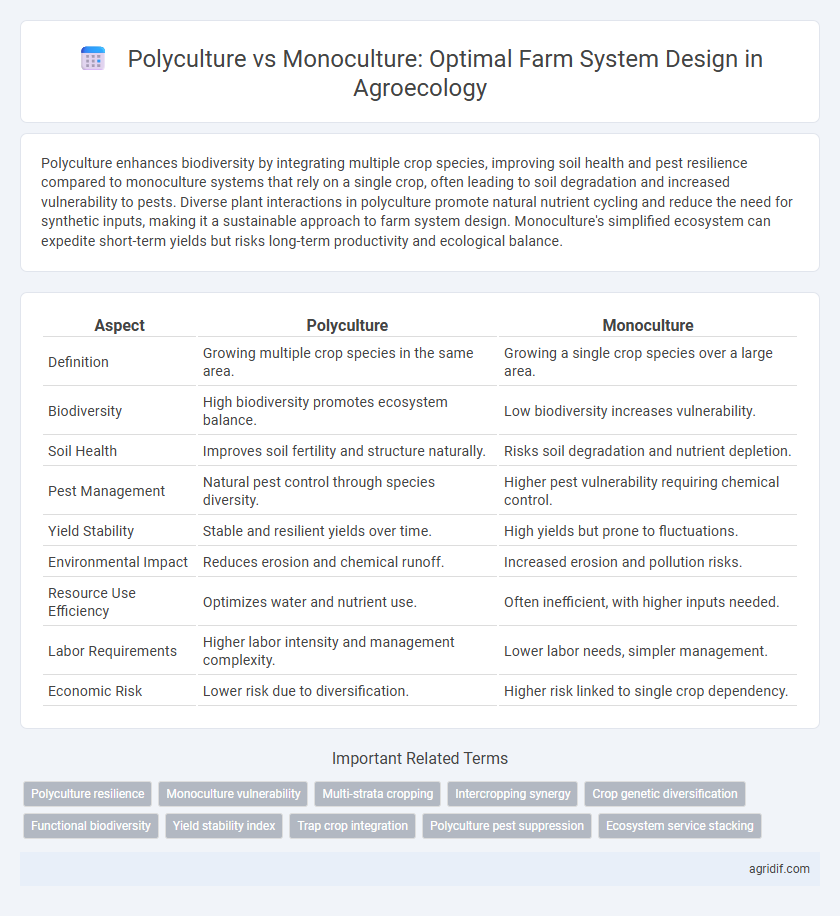
 Polyculture enhances biodiversity by integrating multiple crop species, improving soil health and pest resilience compared to monoculture systems that rely on a single crop, often leading to soil degradation and increased vulnerability to pests. Diverse plant interactions in polyculture promote natural nutrient cycling and reduce the need for synthetic inputs, making it a sustainable approach to farm system design. Monoculture's simplified ecosystem can expedite short-term yields but risks long-term productivity and ecological balance.
Table of Comparison
| Aspect | Polyculture | Monoculture |
|---|---|---|
| Definition | Growing multiple crop species in the same area. | Growing a single crop species over a large area. |
| Biodiversity | High biodiversity promotes ecosystem balance. | Low biodiversity increases vulnerability. |
| Soil Health | Improves soil fertility and structure naturally. | Risks soil degradation and nutrient depletion. |
| Pest Management | Natural pest control through species diversity. | Higher pest vulnerability requiring chemical control. |
| Yield Stability | Stable and resilient yields over time. | High yields but prone to fluctuations. |
| Environmental Impact | Reduces erosion and chemical runoff. | Increased erosion and pollution risks. |
| Resource Use Efficiency | Optimizes water and nutrient use. | Often inefficient, with higher inputs needed. |
| Labor Requirements | Higher labor intensity and management complexity. | Lower labor needs, simpler management. |
| Economic Risk | Lower risk due to diversification. | Higher risk linked to single crop dependency. |
Understanding Polyculture and Monoculture Systems
Polyculture systems integrate multiple crop species in a single farming area, enhancing biodiversity, improving soil health, and reducing pest outbreaks through natural pest control mechanisms. Monoculture systems focus on cultivating a single crop species, which can lead to higher short-term yields but often result in soil nutrient depletion and increased vulnerability to pests and diseases. Understanding these differences is crucial for designing farm systems that balance productivity with ecosystem sustainability and resilience.
Historical Perspectives on Farm System Design
Polyculture systems historically dominated traditional agricultural practices, promoting biodiversity and resilience by integrating multiple crop species in the same area, which helped maintain soil fertility and reduce pest outbreaks. In contrast, monoculture emerged prominently during the Industrial Revolution, driven by mechanization and the demand for high-yield single crops, often resulting in soil degradation and increased vulnerability to pests and diseases. The shift from polyculture to monoculture reflects changing socio-economic priorities and technological advancements that have shaped modern farm system design.
Biodiversity Impacts in Polyculture vs Monoculture
Polyculture systems enhance biodiversity by cultivating multiple crop species simultaneously, which promotes diverse habitats for beneficial insects, soil microbes, and wildlife, thereby improving ecosystem resilience. In contrast, monoculture farms typically reduce biodiversity due to uniform crop planting, increasing vulnerability to pests, diseases, and soil degradation. Enhanced biodiversity in polyculture leads to better pest control, improved soil health, and greater overall productivity in sustainable farm system design.
Resource Use Efficiency and Soil Health
Polyculture enhances resource use efficiency by promoting diverse root structures and crop interactions that optimize nutrient uptake and water retention, reducing the need for synthetic inputs. This diversified system improves soil health through increased organic matter, better microbial activity, and enhanced soil structure, which collectively mitigate erosion and nutrient depletion. In contrast, monoculture often leads to nutrient imbalances, soil degradation, and increased vulnerability to pests, necessitating higher input use and negatively impacting long-term soil sustainability.
Pest and Disease Management Strategies
Polyculture enhances pest and disease management by increasing biodiversity, which disrupts pest life cycles and supports natural predator populations, reducing reliance on chemical controls. In contrast, monoculture systems often create homogenous environments that facilitate rapid pest and disease spread due to uniform host availability. Implementing diverse crop rotations and intercropping in polyculture systems promotes ecosystem resilience and sustainable pest suppression, improving overall farm health.
Economic Viability and Farm Productivity
Polyculture systems enhance economic viability by diversifying crop output, reducing pest-related losses, and improving soil health, which collectively increase long-term farm productivity. Monoculture, while often yielding higher short-term output of a single crop, carries risks of soil depletion, market price volatility, and pest outbreaks that can undermine sustained economic returns. Integrating multiple crops in polyculture optimizes resource use efficiency and stabilizes income streams, making it a resilient strategy in agroecological farm design.
Climate Resilience in Diverse Farming Systems
Polyculture systems enhance climate resilience by promoting biodiversity, improving soil health, and increasing pest and disease resistance through diverse crop interactions. In contrast, monoculture farming often leads to soil degradation, nutrient depletion, and higher vulnerability to climate-induced stresses like drought and pests. Integrating polyculture practices supports sustainable farm design by stabilizing yields and reducing reliance on chemical inputs amid changing climate conditions.
Labor Requirements and Farm Management
Polyculture systems demand higher labor input due to diverse crop management, requiring specialized knowledge for planting, pest control, and harvesting multiple species simultaneously. Monoculture simplifies farm management with uniform crop practices, reducing labor intensity but increasing vulnerability to pests and diseases. Efficient labor allocation in polyculture enhances sustainability, while monoculture prioritizes mechanization and cost reduction at the expense of ecological resilience.
Environmental Sustainability and Ecosystem Services
Polyculture systems enhance environmental sustainability by promoting biodiversity, improving soil health, and reducing pest outbreaks compared to monoculture practices. Diverse crop species in polyculture contribute to better nutrient cycling and increased resilience against climate variability, supporting vital ecosystem services such as pollination and natural pest control. In contrast, monoculture farming often leads to soil degradation, increased chemical inputs, and diminished habitat complexity, undermining long-term ecosystem stability.
Future Trends and Innovations in Agroecological Design
Polyculture systems enhance biodiversity and resilience by integrating diverse crop species, which improves soil health and pest management compared to monoculture's single-crop approach. Emerging innovations include precision agroecology techniques and sensor-based monitoring that optimize polyculture planting patterns for increased productivity and sustainability. Future trends emphasize regenerative practices and digital tools to scale polyculture benefits, reducing dependency on chemical inputs and mitigating climate change impacts.
Related Important Terms
Polyculture resilience
Polyculture systems enhance farm resilience by promoting biodiversity, improving soil health, and reducing pest and disease outbreaks through natural ecological interactions. Unlike monoculture, which relies on a single crop species and increases vulnerability to environmental stresses, polyculture integrates multiple crops, fostering ecosystem stability and long-term productivity.
Monoculture vulnerability
Monoculture farming systems exhibit increased vulnerability to pests, diseases, and environmental stress due to genetic uniformity and lack of biodiversity. In contrast, polyculture enhances ecosystem resilience by promoting natural pest control and soil health through diverse plant species integration.
Multi-strata cropping
Multi-strata cropping in polyculture systems enhances biodiversity and resilience by integrating multiple plant species at different vertical layers, optimizing resource use and improving soil health. In contrast, monoculture relies on single crops, which often leads to soil degradation and increased pest vulnerability due to lack of ecological diversity.
Intercropping synergy
Polyculture systems enhance farm resilience and productivity by leveraging intercropping synergy, where complementary crops improve nutrient cycling, pest control, and soil health compared to monoculture practices. Intercropping diverse plant species creates microenvironments that optimize light, water, and nutrient use efficiency, leading to higher overall yields and ecological stability.
Crop genetic diversification
Polyculture enhances crop genetic diversification by integrating multiple crop species, which increases resilience against pests, diseases, and climate variability compared to monoculture systems that rely on a single crop genotype. Diverse genetic pools in polyculture improve soil health and promote sustainable farm system design through ecological interactions and resource use efficiency.
Functional biodiversity
Polyculture enhances functional biodiversity by integrating diverse crop species that support ecosystem services such as pest control, soil fertility, and pollination, leading to increased resilience and sustainability in farm systems. Monoculture, characterized by single-crop dominance, often reduces functional biodiversity, increasing vulnerability to pests, diseases, and soil degradation, thereby compromising long-term productivity.
Yield stability index
Polyculture systems enhance Yield Stability Index by promoting biodiversity and reducing pest outbreaks, leading to consistent crop production across seasons compared to monoculture's vulnerability to environmental stressors. Monoculture often shows higher short-term yields but lower yield stability due to reliance on a single crop, increasing risk of crop failure under variable climatic conditions.
Trap crop integration
Polyculture systems enhance biodiversity and pest management by integrating trap crops that attract pests away from main crops, reducing reliance on chemical pesticides. In contrast, monoculture systems lack this natural pest control mechanism, often leading to increased vulnerability to pest outbreaks and higher input costs.
Polyculture pest suppression
Polyculture enhances pest suppression by promoting biodiversity and natural predator habitats, reducing the reliance on chemical pesticides compared to monoculture systems. Integrating multiple crop species disrupts pest life cycles and increases ecosystem resilience, leading to healthier, more sustainable farm designs.
Ecosystem service stacking
Polyculture farming enhances ecosystem service stacking by increasing biodiversity, improving soil health, and promoting natural pest control compared to monoculture systems that often degrade these services due to reduced species variety and soil depletion. Integrating multiple crop species in a single farm system design maximizes nutrient cycling, water retention, and resilience against climate variability, thereby supporting sustainable agroecological outcomes.
Polyculture vs Monoculture for farm system design Infographic