 agridif.com
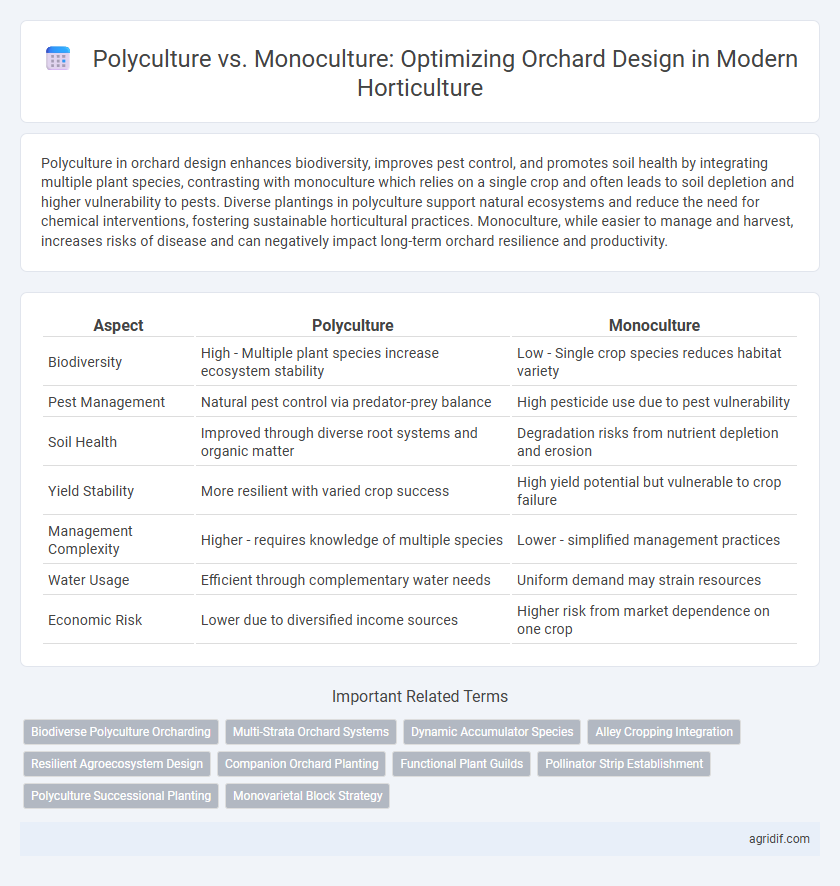
 Polyculture in orchard design enhances biodiversity, improves pest control, and promotes soil health by integrating multiple plant species, contrasting with monoculture which relies on a single crop and often leads to soil depletion and higher vulnerability to pests. Diverse plantings in polyculture support natural ecosystems and reduce the need for chemical interventions, fostering sustainable horticultural practices. Monoculture, while easier to manage and harvest, increases risks of disease and can negatively impact long-term orchard resilience and productivity.
Table of Comparison
| Aspect | Polyculture | Monoculture |
|---|---|---|
| Biodiversity | High - Multiple plant species increase ecosystem stability | Low - Single crop species reduces habitat variety |
| Pest Management | Natural pest control via predator-prey balance | High pesticide use due to pest vulnerability |
| Soil Health | Improved through diverse root systems and organic matter | Degradation risks from nutrient depletion and erosion |
| Yield Stability | More resilient with varied crop success | High yield potential but vulnerable to crop failure |
| Management Complexity | Higher - requires knowledge of multiple species | Lower - simplified management practices |
| Water Usage | Efficient through complementary water needs | Uniform demand may strain resources |
| Economic Risk | Lower due to diversified income sources | Higher risk from market dependence on one crop |
Defining Polyculture and Monoculture in Orchard Systems
Polyculture in orchard design involves cultivating multiple fruit tree species or varieties within the same area, promoting biodiversity and enhancing ecosystem resilience. Monoculture refers to growing a single fruit species intensively over a large area, simplifying management but increasing vulnerability to pests and diseases. Understanding these definitions aids in selecting orchard systems that balance productivity with ecological stability.
Key Differences Between Polyculture and Monoculture Orchards
Polyculture orchards integrate multiple plant species, enhancing biodiversity, pest resistance, and soil health, while monoculture orchards cultivate a single crop species, often leading to higher vulnerability to pests and nutrient depletion. Polyculture systems promote ecological balance and resource efficiency by mimicking natural ecosystems, whereas monoculture relies heavily on chemical inputs and intensive management practices. Yield stability in polyculture tends to be higher under variable environmental conditions compared to the more uniform but risk-prone monoculture systems.
Benefits of Polyculture in Orchard Design
Polyculture in orchard design enhances biodiversity, promoting natural pest control and reducing reliance on chemical pesticides. Diverse plant species improve soil health through varied root structures and nutrient cycling, leading to increased resilience against diseases and environmental stress. Integrating multiple crops creates a more sustainable and productive orchard ecosystem compared to monoculture systems.
Limitations and Challenges of Monoculture Orchards
Monoculture orchards face significant limitations such as increased vulnerability to pests and diseases due to genetic uniformity, leading to higher pesticide usage and environmental impact. Soil depletion and reduced biodiversity further challenge sustainability by weakening the ecosystem's natural resilience. These factors contribute to long-term productivity decline and greater management costs compared to more diverse orchard systems.
Impact on Soil Health: Polyculture vs Monoculture
Polyculture orchard design enhances soil health by increasing biodiversity, promoting nutrient cycling, and improving microbial activity, which leads to better soil structure and fertility. Monoculture practices often degrade soil quality over time due to nutrient depletion, increased vulnerability to pests, and reduced organic matter. Integrating multiple plant species in orchards supports sustainable soil ecosystems, reducing the need for chemical fertilizers and pesticides.
Pest and Disease Management in Diverse Orchards
Polyculture in orchard design enhances pest and disease management by promoting biodiversity that disrupts pest life cycles and supports beneficial predators, reducing the reliance on chemical controls. Diverse orchards create microclimates and improve soil health, which boost plant resilience against pathogens compared to monoculture systems that often suffer from rapid pest and disease spread due to uniform host availability. Implementing polyculture strategies in horticulture optimizes orchard ecosystem services, ensuring sustainable crop protection and long-term productivity.
Biodiversity Enhancement through Polyculture
Polyculture orchard design significantly enhances biodiversity by incorporating multiple tree species and companion plants, which supports a wider range of beneficial insects, birds, and soil microorganisms. This diverse ecosystem improves pest control, pollination efficiency, and soil health compared to monoculture systems dominated by a single species. Promoting biodiversity through polyculture also increases orchard resilience to diseases and environmental stressors, fostering sustainable horticultural productivity.
Yield and Economic Considerations for Orchard Growers
Polyculture in orchard design often enhances yield stability by promoting biodiversity and reducing pest outbreaks, leading to more consistent long-term productivity compared to monoculture systems. Economic considerations favor polyculture due to diversified income streams and lower input costs related to pest control and soil management, whereas monoculture can offer higher short-term yields but increases vulnerability to market fluctuations and disease outbreaks. Growers evaluating orchard systems must balance the immediate economic benefits of monoculture with the sustainable advantages and risk mitigation provided by polyculture practices.
Practical Examples of Polyculture Orchard Layouts
Polyculture orchard layouts, such as apple trees interplanted with nitrogen-fixing legumes and aromatic herbs, enhance biodiversity and soil health while reducing pest pressure naturally. In contrast to monoculture systems that grow a single fruit species, these mixed-species designs increase overall yield stability and resilience against climate variability. Practical examples include alley cropping with fruit trees combined with berry bushes and cover crops that optimize space and nutrient cycling in temperate orchard environments.
Choosing the Right Orchard Design for Sustainability
Polyculture orchard design enhances biodiversity, improving pest resistance and soil health by integrating multiple fruit tree species and companion plants. Monoculture systems simplify management but often lead to increased vulnerability to pests, diseases, and nutrient depletion, requiring higher inputs of chemicals and fertilizers. Selecting an orchard design that balances crop diversity with site conditions promotes long-term sustainability and resilience in fruit production.
Related Important Terms
Biodiverse Polyculture Orcharding
Biodiverse polyculture orcharding enhances soil health, pest resistance, and ecosystem resilience by integrating multiple complementary fruit and nut tree species with understory plants, fostering beneficial insects and microbial diversity. This approach contrasts with monoculture orchards, which often suffer from nutrient depletion, increased pest outbreaks, and vulnerability to diseases due to genetic uniformity.
Multi-Strata Orchard Systems
Multi-strata orchard systems integrate polyculture by layering diverse plant species with various heights and root depths, enhancing biodiversity, soil health, and pest resistance compared to monoculture designs that rely on a single crop species. This approach optimizes resource use efficiency and ecosystem services, promoting sustainable orchard productivity and resilience.
Dynamic Accumulator Species
Dynamic accumulator species enhance orchard polyculture by improving nutrient cycling and soil fertility through deep root systems that capture and recycle minerals, unlike monoculture systems which often deplete soil nutrients and require synthetic inputs. Integrating plants such as comfrey, dandelion, and nettle within polyculture orchards supports sustainable growth, pest resistance, and long-term ecosystem resilience.
Alley Cropping Integration
Alley cropping integration in orchard design enhances biodiversity and soil health by combining polyculture's multiple tree species with annual crops planted in alleys, which improves pest control and nutrient cycling compared to monoculture orchards. This method increases overall yield resilience and maximizes land use efficiency by leveraging complementary interactions between diverse plant species.
Resilient Agroecosystem Design
Polyculture in orchard design enhances biodiversity and soil health by integrating multiple plant species, fostering a resilient agroecosystem capable of withstanding pests and climate variability. Monoculture orchards, while efficient for uniform crop management, often increase vulnerability to disease and reduce long-term sustainability due to limited genetic diversity.
Companion Orchard Planting
Companion orchard planting in polyculture enhances biodiversity, pest control, and soil health by combining multiple complementary fruit tree species and beneficial plants, creating a resilient ecosystem. Monoculture orchards, while easier to manage, often suffer from increased vulnerability to pests and diseases due to lack of plant diversity and reduced ecological interactions.
Functional Plant Guilds
Polyculture orchard design enhances ecosystem resilience by integrating Functional Plant Guilds, which combine complementary species to improve nutrient cycling, pest control, and pollination. Monoculture, lacking this diversity, often requires higher chemical inputs and faces greater vulnerability to pests and diseases, reducing long-term sustainability.
Pollinator Strip Establishment
Establishing pollinator strips in polyculture orchard designs significantly enhances biodiversity and pollination efficiency by attracting a diverse range of pollinators compared to monoculture systems. Incorporating flowering plants with staggered bloom periods in these strips supports sustained pollinator activity, improving fruit set and overall orchard productivity.
Polyculture Successional Planting
Polyculture successional planting in orchard design enhances biodiversity by integrating multiple plant species with staggered growth cycles, promoting natural pest resistance and soil health. This approach outperforms monoculture by reducing disease vulnerability and improving long-term orchard resilience through continuous nutrient cycling and habitat diversity.
Monovarietal Block Strategy
Monovarietal block strategy in orchard design enhances disease management and harvesting efficiency by cultivating a single apple variety per block, reducing cross-infection risks and simplifying orchard operations. Polyculture, while promoting biodiversity and resilience, can complicate pest control and labor due to mixed species interactions and varying growth habits.
Polyculture vs Monoculture for orchard design Infographic